

- “Wait, can I come back to the email question? I gave you the wrong one.”
- “Before we book, what’s your cancellation policy?”
- “I already told you that, can we skip ahead?”
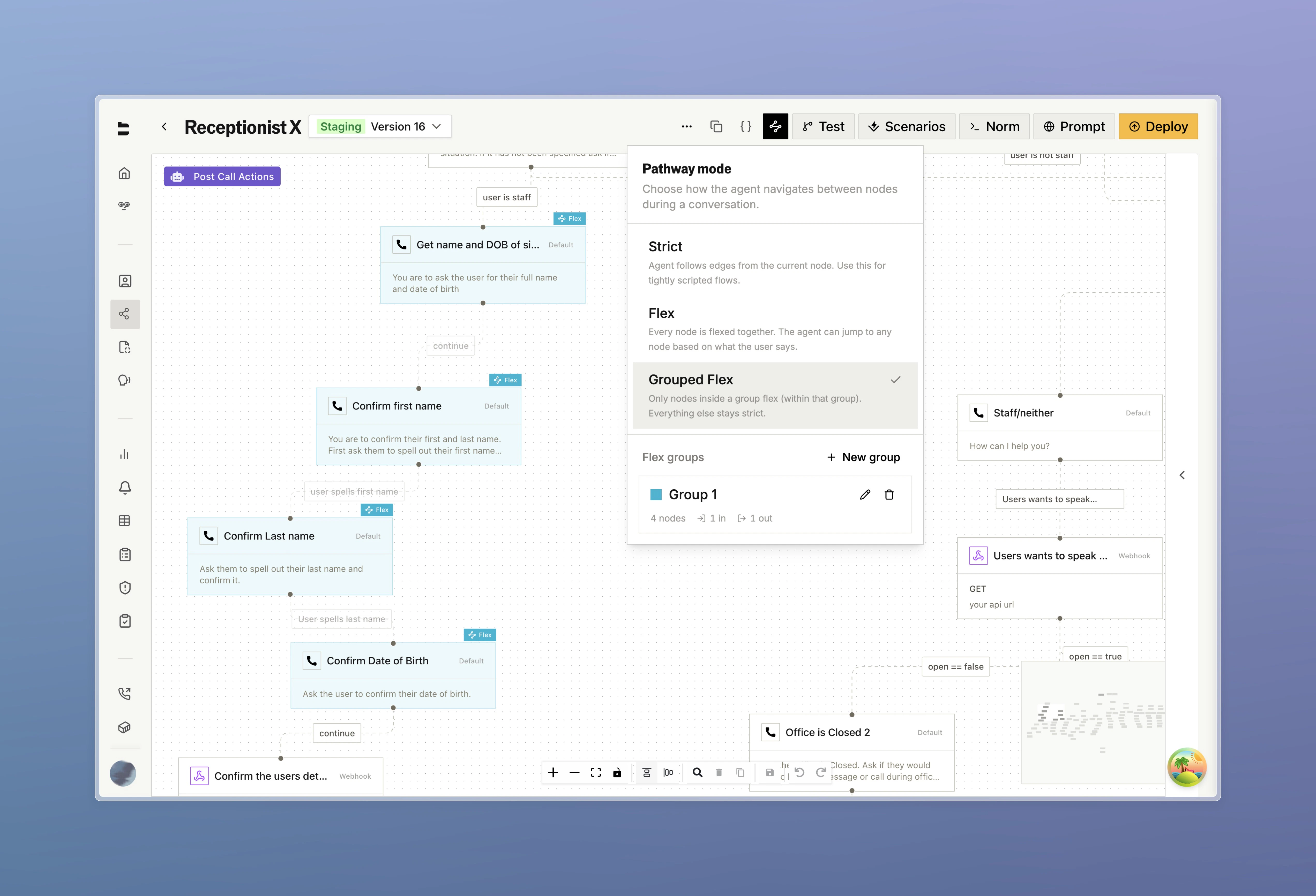
When to use it
Use Flex Mode when...
The order is fluid: discovery, sales, or support chats where the user can ask about anything in any order.
Use strict mode when...
The order matters: auth flows, scripted disclosures, ordered data collection, or compliance.
How it works
Each turn, the agent looks at:- The nodes available to flex to (the flex scope)
- The recent chat history
- The current node
- The current node’s outgoing edges, surfaced as preferred next steps
- Edges are suggestions, not commands. The agent can override them when the conversation has clearly shifted.
- Backtracking and skipping work. The agent can re-pick a node already visited, or jump to one not yet reached.
- No new prompts to write. Flex uses the node names and prompts you already have.
Enabling Flex Mode
Click on the “Flex” button in the pathway page header and set the mode to Flex.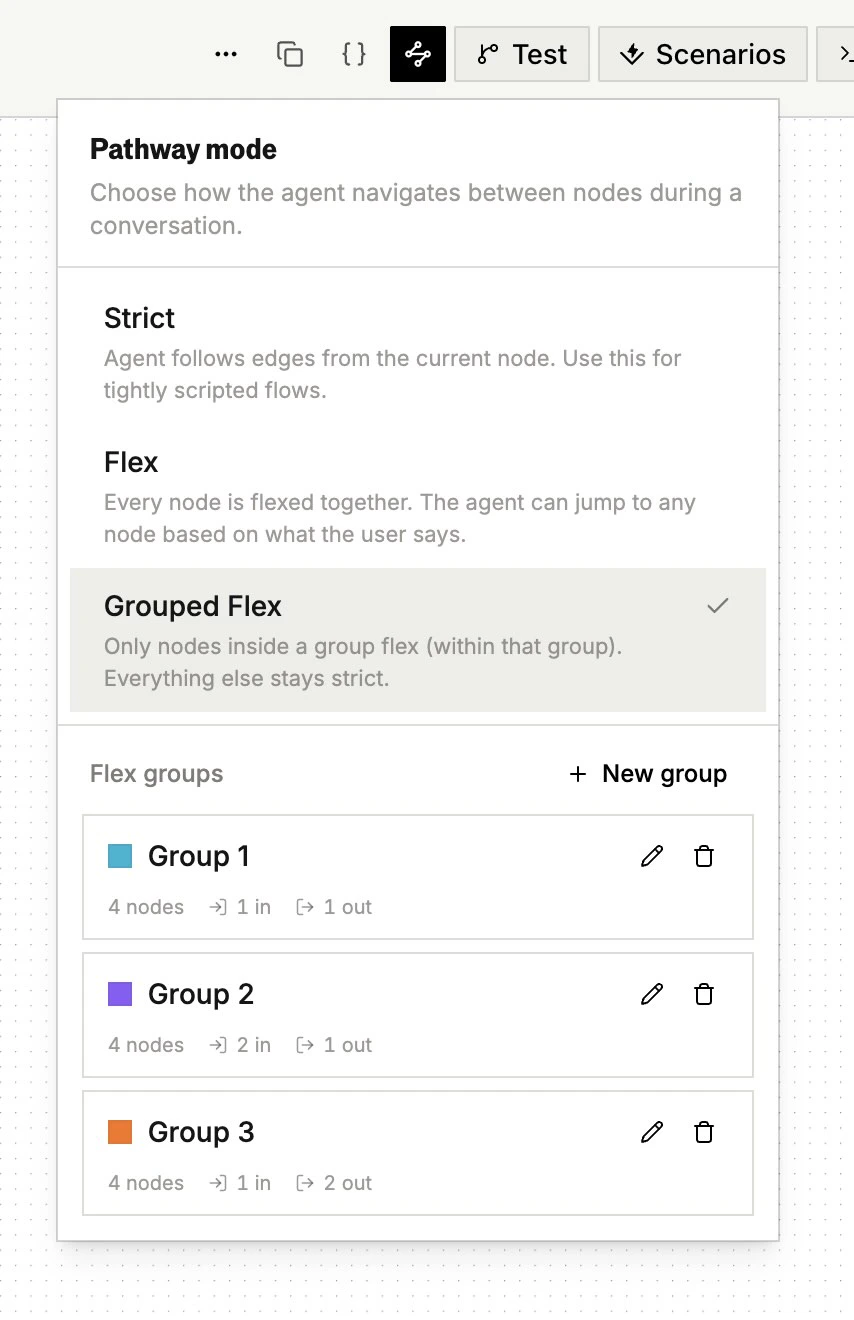
Flex Groups
A Flex Group is a named, color-coded set of nodes that flex together. You can have multiple groups in one pathway. Nodes outside every group stay strict.Behavior
- A node can belong to only one group.
- If current node is inside Group 1, then the agent can move to any other node in Group 1, plus follow the current node’s edges as suggestions (even if they are not in the group).
- If current node is outside any group, then the agent is in strict mode. Edges are followed, not suggested.
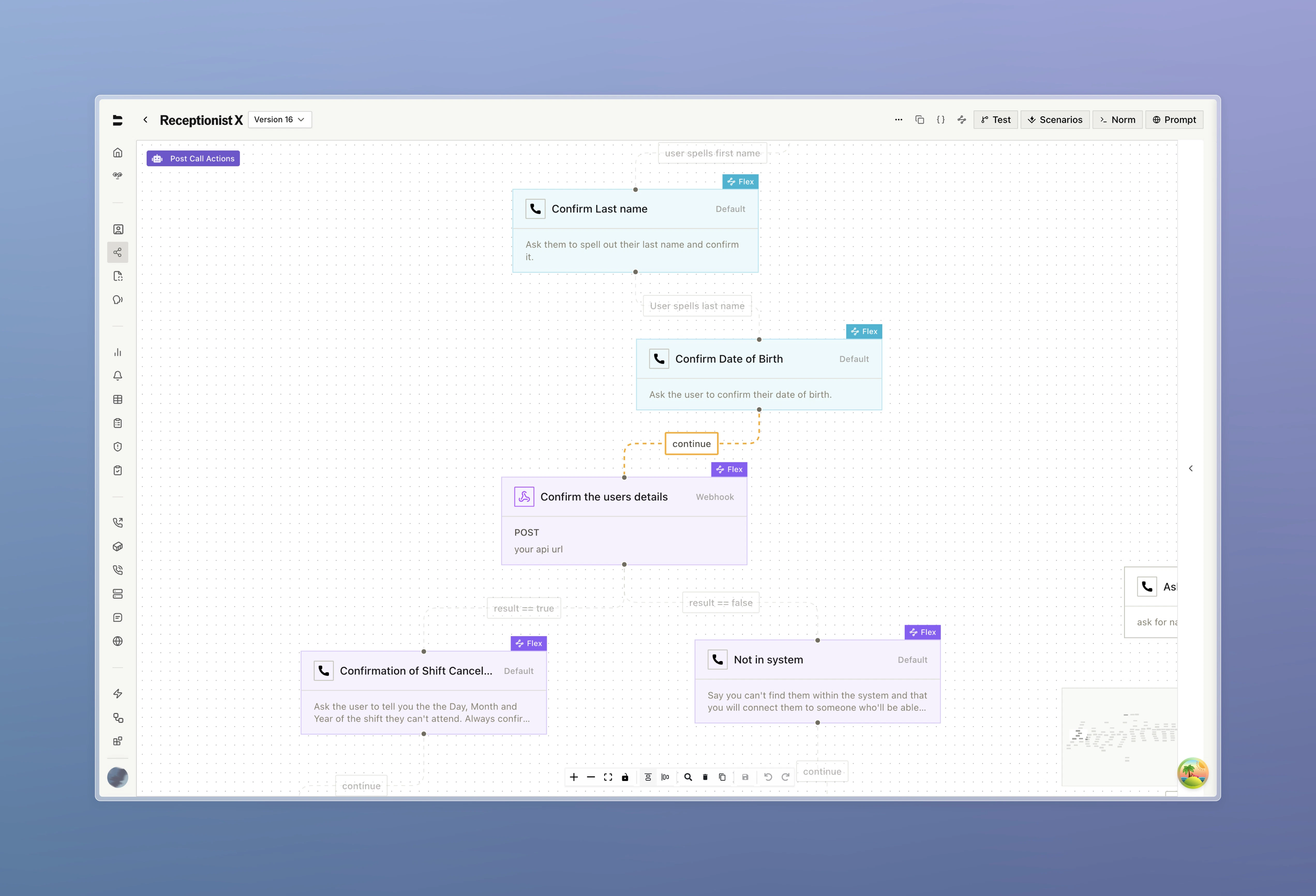
Creating a group
- Open the flex dropdown and click on “Flex Groups”
- Click + New Group and pick a color
- Nodes can be toggled on and off, or you can drag to select a group of nodes
- Save the group. Nodes inside the group will have a tag with the group color.
Common patterns
Within-group vs. exit routing
Inside a Flex Group, the agent sees two kinds of candidates:- Preferred next nodes: the current node’s outgoing edges.
- Other nodes in the group: off-script candidates.
Conditional edges that exit the group
If an exit edge has a structured condition (e.g.open == true), it’s evaluated against the current call variables before the agent picks. The result is shown alongside the edge label. Matching edges get a strong bias, but the agent can still stay in the group if the conversation calls for it.
Edges between nodes inside the group are not pre-evaluated. They’re still shown to the agent as part of the current node’s preferred next steps, just without an evaluated result.
Best practices
Write clear node names and prompts
The agent decides where to flex based on what each node says it does. “Node 3” with no prompt forces a guess. Bad:Keep groups small
Aim for 3–20 nodes per group, each with a distinct purpose.Use strict edges where order matters
Use strict edges deliberately for:- Conversation phase hand-offs (discovery to pitch).
- Ordered steps inside a group (authenticate before access).
- Webhook responses where a variable should decide.
Interactions with other features
Webhooks and tool calls
Webhook response pathways targeting a node outside the current group appear alongside the current node’s edges, with their condition pre-evaluated. Targets inside the group are reachable through normal group membership.Global nodes
Global Nodes work the same in Flex Mode as in strict mode. They are not flex candidates.Troubleshooting
The agent keeps jumping out of where I want it
The agent keeps jumping out of where I want it
The group is probably too large, or node prompts overlap. Check:
- Are node prompts distinct enough to tell apart?
- Is the right next node in the same group, or a different one?
- Have you included a “wrap up” node in a discovery group by mistake?
The agent won't go where I drew the edge
The agent won't go where I drew the edge
Two common causes:
- The target is in the same group. The agent picks freely within a group, so your edge is a suggestion.
- The edge has a structured condition and the variable isn’t set as expected. Check extracted variables in the logs.