

Contact Memory Sync to HubSpot & Salesforce
Bland’s memory now syncs to your CRM at the contact level after every call and message, with no tool setup or per-call request data required. Connect HubSpot or Salesforce through a single OAuth modal and sync turns on automatically, pushing each contact’s identity, rolling conversation summary, memory entities (bookings, orders, tickets), and deals/opportunities straight onto the contact record.- Every conversation automatically creates or updates the CRM contact with notes and summaries, and keeps open items like appointments and deals up to date across their lifecycle
- Bland can also pull context back in from your CRM to enrich its own contact memory, so agents reference it without any extra configuration
- A redesigned Contacts view shows per-contact sync status inline (synced / partial / failed), with Sync now on each contact and a Sync all backfill to push everything Bland already knows when you first connect
Agent Testing & Simulations
Your eval agents can now grade fully simulated conversations, not just real call history, so you can catch regressions before an agent ever touches a live customer. Attach a roster of eval agents to a scenario, generate a batch of simulated runs, and each conversation is scored inline against your rubrics.- Attach eval agents directly to a scenario and score every simulated run with the same rubric-based engine that grades your real calls
- Kick off a simulation and get results back asynchronously: large runs no longer block or time out, and each run reports its status and score in the new runs panel
- Reworked evals call-picker and filter bar: a single-row filter with add-filter predicates, removable chips, a time-range selector, and one-click auto-sampling
SIP Outbound: Bring-Your-Own DIDs & Trunk-to-Trunk
Outbound SIP calls can now use your own internal identities (DIDs and extensions) instead of being forced onto an E.164, enabling true trunk-to-trunk hand-off where Bland passes the call to your system and you take it from there.- Identities are stored exactly as you enter them: only
+-prefixed inputs are parsed as E.164, while DIDs and extensions are kept verbatim and no longer coerced into duplicate rows - Custom headers and Bland variables set on a call are now correctly carried through on the outbound INVITE, with static-vs-variable header round-tripping preserved end to end
- Fixed the outbound INVITE so it carries the correct FROM and TO instead of duplicating the source number
Knowledge Base: Retrieval Boost for Web & JSON Sources
Retrieval boosting (previously CSV-only) now works for Web and JSON knowledge sources, so you can steer which fields and paths carry the most weight during retrieval.- JSON sources get dedicated boost/ignore JSONPath inputs plus a list-path field, all validated as you type
- Web sources can boost on page title and meta description with a single toggle
- Saving now runs an automatic save-then-reindex, with the retrieval settings locked while the update is in flight
Improvements
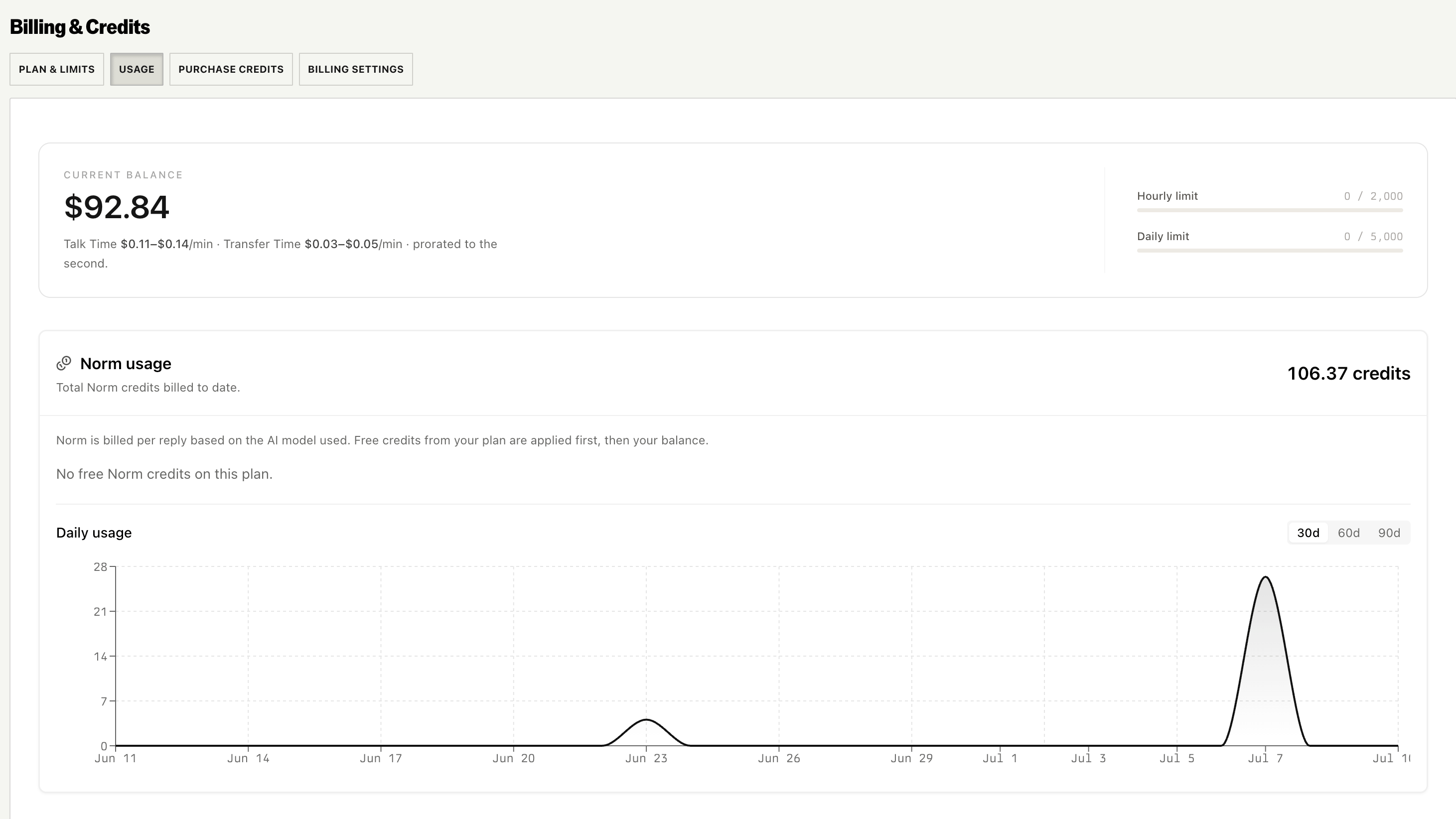
Billing- A new Usage tab surfaces usage-based billing for eligible orgs, with a Norm usage chart (30/60/90-day toggle) and a free-credit panel. Usage-based orgs see “Usage-based billing” in the account selector, and Norm usage is now pulled from Metronome into the org billing summary
- The per-node tool-call cap is now configurable with a new Max calls control, so iterative tools that need more than 3 calls per node can run to completion
- Export to GitHub is now lossless on round-trip (node configuration is preserved on export and restored on import) and handles bulk exports gracefully with proper rate-limit responses instead of intermittent 500s
- Loop condition prompt logs now preserve the original prompt used at call time instead of showing later edits
- SMS conversations can now be exported from the logs UI as CSV, matching the call-logs export format
- Messaging/SMS webhook log entries now support Resend, matching the post-call webhook resend in call logs
- SMS automation variables now persist until explicitly replaced