> ## Documentation Index
> Fetch the complete documentation index at: https://docs.bland.ai/llms.txt
> Use this file to discover all available pages before exploring further.
# JWT Signature Configuration
> Asymmetric JWT signing for enterprise-grade webhook and request authentication
## Overview
Traditional webhook authentication using shared secrets creates critical vulnerabilities: secrets must be distributed and stored securely, rotation requires coordinating both parties, and any compromise affects all integrations.
JWT signatures eliminate these risks through asymmetric cryptography - you verify requests using our public JWKS endpoint without storing any secrets, while we can rotate keys unilaterally without disrupting your service. This zero-trust approach provides cryptographic proof of authenticity, integrity, and origin for every request, with built-in replay prevention through unique token identifiers.
## Security Guarantees
Each JWT token provides cryptographic proof of:
1. **Authenticity**: Request originated from Bland's infrastructure (verified via signature)
2. **Integrity**: Payload hasn't been modified (signature breaks if tampered)
3. **Non-repudiation**: Bland cannot deny sending the request
4. **Replay prevention**: Unique `jti` (UUIDv7) prevents token reuse
5. **Time-boxing**: `iat`, `nbf`, and `exp` claims enforce temporal validity
## Token Structure
Every JWT Bland issues contains these claims and headers:
| Header | Type | Purpose | Validation Required |
| ------ | ------ | -------------------------- | ----------------------------- |
| `alg` | String | Signing algorithm (RS256) | Must be `RS256` |
| `typ` | String | Token type (JWT) | Must be `JWT` |
| `kid` | String | Key ID for key pair lookup | Must match a key in your JWKS |
| Claim | Type | Purpose | Validation Required |
| ----- | -------------- | ----------------------- | ----------------------------------------------- |
| `sub` | String | Org ID | Must match your application's Bland Org ID |
| `jti` | UUIDv7 | Unique token identifier | Track to prevent replay attacks |
| `iat` | Unix timestamp | Issued at time | Reject if future (clock skew) |
| `nbf` | Unix timestamp | Not valid before | Reject if current time \< nbf |
| `exp` | Unix timestamp | Expiration time | Reject if expired |
| `iss` | String | Issuer URL | Must match `https://api.bland.ai/orgs/{org_id}` |
| `aud` | String | Intended recipient | Must match your service identifier |
## Configuration
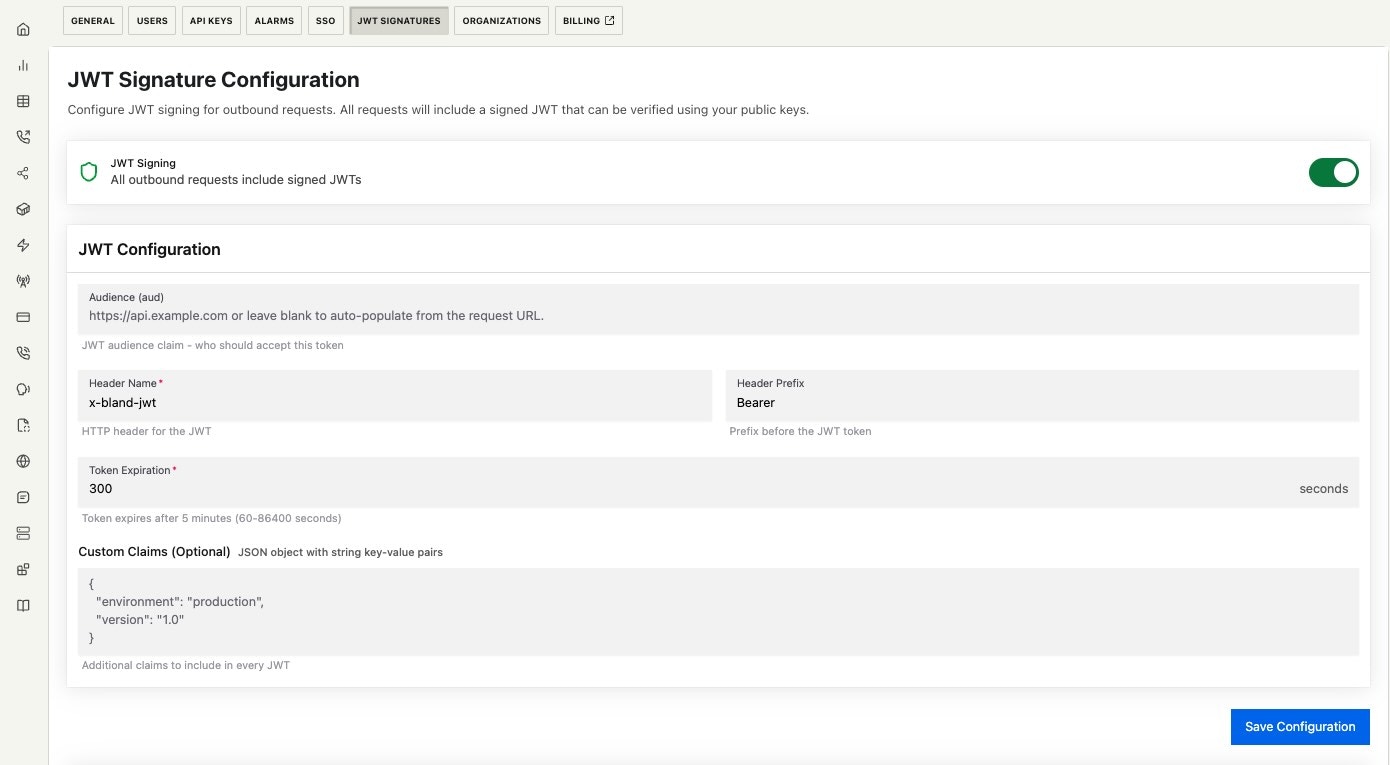 ### Core Settings
**JWT Signing**: Master toggle for signature generation
**Audience (aud)**:
* Leave blank: Auto-populates with request's base URL in the form of protocol://host
* Custom value: Use for service mesh routing (e.g., `svc:webhook-processor`)
* Examples (when auto populated):
* `https://webhooks.yourdomain.com?queryparam=value` => `https://webhooks.yourdomain.com`
* `https://api.yourdomain.com/v1/endpoint` => `https://api.yourdomain.com`
* Use the "Include Protocol" option to control whether the `https://` prefix is included in the `aud` claim.
**Token Expiration**: Seconds until token expires (300-3600)
* Shorter = Better security, more clock skew issues
* Longer = More tolerant, larger replay window
**Custom Claims**: Additional JSON claims for request context
```json theme={null}
{
"environment": "production",
"tenant_id": "tenant_123",
"request_type": "webhook"
}
```
## Key Management
### JWKS Endpoint
Public keys available at:
```
https://api.bland.ai/orgs/{org-id}/.well-known/jwks.json
```
This endpoint is public by design - no authentication required or desired.
### Rotation Strategy
**Standard Rotation**:
* New key generated with unique `kid`
* 24-hour overlap with previous keys (max 3 active)
* In-flight requests remain valid during transition
* Your cached JWKS continues working
**Emergency Revocation**:
* Immediately invalidates ALL tokens
* Use only for confirmed compromise
* Will break in-flight requests
* Requires immediate cache purge on your side
## Implementation
### Verification Example
```typescript theme={null}
import { createRemoteJWKSet, jwtVerify } from "jose";
const JWKS = createRemoteJWKSet(
new URL("https://api.bland.ai/orgs/{org_id}/.well-known/jwks.json")
);
// Track JTIs to prevent replay (use Redis/DB in production)
const seenTokens = new Set();
async function verifyRequest(token: string) {
const { payload } = await jwtVerify(token, JWKS, {
issuer: `https://api.bland.ai/orgs/${org_id}`,
audience: "your-service-identifier",
});
// Prevent replay attacks
if (seenTokens.has(payload.jti)) {
throw new Error("Token replay detected");
}
seenTokens.add(payload.jti);
return payload;
}
```
### Cache Invalidation Strategy
When verification fails with an unknown `kid`:
1. Force refresh your JWKS cache immediately
2. Retry verification once with fresh keys
3. If still failing, reject the request
4. Log the failure with the `kid` for investigation
Rate limit cache refreshes to prevent DoS attacks (minimum 5 seconds between refreshes).
## Security Considerations
### Why This Prevents Breaches
**Compromised database**: Attacker finds your database backup
* Shared secret: Can forge webhooks immediately
* JWT: No secrets stored, cannot forge signatures
**MITM attack**: Attacker intercepts webhook traffic
* Shared secret: Can replay requests or extract secret
* JWT: Can replay only until `exp`, cannot forge new requests
**Insider threat**: Malicious employee wants to forge webhooks
* Shared secret: Anyone with production access has the secret
* JWT: Would need Bland's private key (never exposed)
**Partner compromise**: Another Bland customer gets breached
* Shared secret: If secrets are reused, you're affected
* JWT: Each org has unique issuer, no cross-contamination
### Production Requirements
1. **Always verify** `jti` uniqueness within the token's lifetime
2. **Cache JWKS** for 1-24 hours, refresh on unknown `kid`
3. **Implement replay prevention** using Redis or similar
4. **Monitor verification failures** - spike indicates rotation or attack
5. **Set clock tolerance** to ±30 seconds for distributed systems
6. **Never accept** tokens with future `iat` (issued-at) times
## Troubleshooting
**Cause**: Key rotation occurred, your cache has old keys
**Fix**: Force JWKS cache refresh and retry once
{" "}
**Cause**: Clock skew or network latency exceeding token lifetime **Fix**:
Increase token expiration to 600-900 seconds
{" "}
**Cause**: Retry logic or load balancer sending duplicate requests **Fix**:
Implement idempotency keys separate from JWT `jti`
**Cause**: All keys invalidated, including cached ones
**Fix**: Manually purge JWKS cache and fetch fresh keys
***
Docs for agents: [llms.txt](/llms.txt)
### Core Settings
**JWT Signing**: Master toggle for signature generation
**Audience (aud)**:
* Leave blank: Auto-populates with request's base URL in the form of protocol://host
* Custom value: Use for service mesh routing (e.g., `svc:webhook-processor`)
* Examples (when auto populated):
* `https://webhooks.yourdomain.com?queryparam=value` => `https://webhooks.yourdomain.com`
* `https://api.yourdomain.com/v1/endpoint` => `https://api.yourdomain.com`
* Use the "Include Protocol" option to control whether the `https://` prefix is included in the `aud` claim.
**Token Expiration**: Seconds until token expires (300-3600)
* Shorter = Better security, more clock skew issues
* Longer = More tolerant, larger replay window
**Custom Claims**: Additional JSON claims for request context
```json theme={null}
{
"environment": "production",
"tenant_id": "tenant_123",
"request_type": "webhook"
}
```
## Key Management
### JWKS Endpoint
Public keys available at:
```
https://api.bland.ai/orgs/{org-id}/.well-known/jwks.json
```
This endpoint is public by design - no authentication required or desired.
### Rotation Strategy
**Standard Rotation**:
* New key generated with unique `kid`
* 24-hour overlap with previous keys (max 3 active)
* In-flight requests remain valid during transition
* Your cached JWKS continues working
**Emergency Revocation**:
* Immediately invalidates ALL tokens
* Use only for confirmed compromise
* Will break in-flight requests
* Requires immediate cache purge on your side
## Implementation
### Verification Example
```typescript theme={null}
import { createRemoteJWKSet, jwtVerify } from "jose";
const JWKS = createRemoteJWKSet(
new URL("https://api.bland.ai/orgs/{org_id}/.well-known/jwks.json")
);
// Track JTIs to prevent replay (use Redis/DB in production)
const seenTokens = new Set();
async function verifyRequest(token: string) {
const { payload } = await jwtVerify(token, JWKS, {
issuer: `https://api.bland.ai/orgs/${org_id}`,
audience: "your-service-identifier",
});
// Prevent replay attacks
if (seenTokens.has(payload.jti)) {
throw new Error("Token replay detected");
}
seenTokens.add(payload.jti);
return payload;
}
```
### Cache Invalidation Strategy
When verification fails with an unknown `kid`:
1. Force refresh your JWKS cache immediately
2. Retry verification once with fresh keys
3. If still failing, reject the request
4. Log the failure with the `kid` for investigation
Rate limit cache refreshes to prevent DoS attacks (minimum 5 seconds between refreshes).
## Security Considerations
### Why This Prevents Breaches
**Compromised database**: Attacker finds your database backup
* Shared secret: Can forge webhooks immediately
* JWT: No secrets stored, cannot forge signatures
**MITM attack**: Attacker intercepts webhook traffic
* Shared secret: Can replay requests or extract secret
* JWT: Can replay only until `exp`, cannot forge new requests
**Insider threat**: Malicious employee wants to forge webhooks
* Shared secret: Anyone with production access has the secret
* JWT: Would need Bland's private key (never exposed)
**Partner compromise**: Another Bland customer gets breached
* Shared secret: If secrets are reused, you're affected
* JWT: Each org has unique issuer, no cross-contamination
### Production Requirements
1. **Always verify** `jti` uniqueness within the token's lifetime
2. **Cache JWKS** for 1-24 hours, refresh on unknown `kid`
3. **Implement replay prevention** using Redis or similar
4. **Monitor verification failures** - spike indicates rotation or attack
5. **Set clock tolerance** to ±30 seconds for distributed systems
6. **Never accept** tokens with future `iat` (issued-at) times
## Troubleshooting
**Cause**: Key rotation occurred, your cache has old keys
**Fix**: Force JWKS cache refresh and retry once
{" "}
**Cause**: Clock skew or network latency exceeding token lifetime **Fix**:
Increase token expiration to 600-900 seconds
{" "}
**Cause**: Retry logic or load balancer sending duplicate requests **Fix**:
Implement idempotency keys separate from JWT `jti`
**Cause**: All keys invalidated, including cached ones
**Fix**: Manually purge JWKS cache and fetch fresh keys
***
Docs for agents: [llms.txt](/llms.txt)